
Hot Keywords:
- All
- Product Name
- Product Keyword
- Product Model
- Product Summary
- Product Description
- Multi Field Search
Please Choose Your Language
Views: 0 Author: Site Editor Publish Time: 2026-09-13 Origin: Site


Choosing between a pontoon and a deck boat presents a classic buyer dilemma. Both remain highly popular options when selecting a recreational boat. However, their underlying architecture forces a clear trade-off. You must decide whether to maximize deck space or prioritize hydrodynamic performance. We will evaluate modern vessels in the 20 to 26-foot range. This size class represents the ideal starting point for most buyers. It includes traditional twin-tube models and advanced tri-toons. Our objective moves beyond superficial feature lists. We will evaluate how hull design shapes your time on the water. You will discover how local water conditions dictate safe handling. We will also explore the distinct maintenance realities associated with each style. By the end, you can confidently choose the right vessel for your specific marine lifestyle.
Capacity vs. Agility: Pontoons offer unmatched usable square footage and flat stability; deck boats provide superior banking, maneuverability, and wake generation.
Water Conditions Dictate Choice: Deck boats handle moderate chop and coastal variations better due to their V-hull, while standard pontoons excel on calm, inland lakes.
Maintenance Realities: Aluminum pontoons require less cosmetic upkeep than fiberglass deck boats but present different winterization and storage challenges.
The Tri-Toon Factor: Adding a third tube bridges the performance gap, making high-end pontoons competitive with deck boats in speed, though at a premium price point.
A deck boat starts with a traditional runabout hull foundation. Builders then flare the fiberglass heavily at the bow. This aggressive flare creates a significantly wider front seating area. You gain much more room forward than you would in a standard bowrider. The hydrodynamic profile remains distinct. A V-hull slices downward through the water. It does not ride entirely on top of the surface. This physical design allows for deep banking. You can safely lean the vessel into tight turns. Drivers experience a highly responsive and sporty feel. The hull digs into the water to carve corners precisely. This carving ability provides a thrilling experience for the captain. It also ensures excellent tracking when navigating tight marinas.
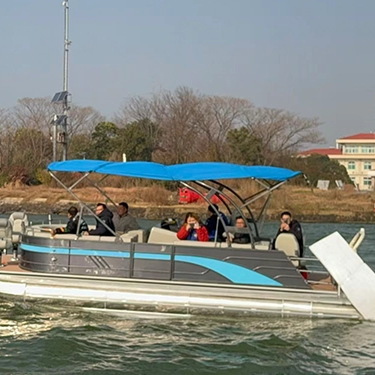
Pontoon design represents a completely different engineering philosophy. Designers bolt a flat structural deck onto large aluminum cylinders. This configuration creates a massive floating platform. The hull relies entirely on surface buoyancy. You ride completely above the water line. Consequently, the vessel turns completely flat. It does not bank into corners. This flat turning dynamic can feel slightly cumbersome to experienced captains. However, it provides ultimate static stability. Passengers can walk freely around the deck without tilting the vessel. You must also differentiate between standard bi-toons and modern tri-toons. A basic two-tube pontoon works perfectly for casual cruising. Adding a third center tube completely transforms the hydrodynamic profile. A three-tube layout supports higher horsepower engines. It also provides the necessary lift for aggressive water sports.
Handling and Performance Summary
Performance Metric | Deck Boat (V-Hull) | Pontoon (Bi-Toon) | Pontoon (Tri-Toon) |
|---|---|---|---|
Turning Radius | Sharp and tight | Wide and flat | Moderate and flat |
Wake Shape | Ramped (Ideal for jumps) | Flat and turbulent | Slightly ramped |
Rough Water Ride | Smooth (Cuts through chop) | Rough (Prone to splashing) | Stable (Center tube breaks chop) |
Draft Depth | Deeper (Requires monitoring) | Very shallow | Shallow to moderate |
Deck boats naturally produce a beautifully shaped wake. This clean, ramped wake proves ideal for wakeboarding and water skiing. The hull design delivers immediate throttle response. You also get a remarkably sharp turning radius. This allows the driver to whip riders quickly across the wake. Pontoons certainly possess the power to pull tubers. This holds true especially when equipped with a 150HP engine or larger. However, the flat wake severely limits advanced tow sports. Skiers struggle to cross the turbulent water behind the tubes. The wider turning radius also restricts aggressive towing maneuvers. If your household demands high-level watersports, the V-hull remains superior.
The sharp V-hull on a deck boat cuts aggressively through wind chop. It slices through the wakes left by other vessels. This slicing action drastically reduces jarring impacts. Your passengers will enjoy a much smoother ride in rough coastal conditions. Pontoons perform excellently on calm inland lakes. Yet, standard bi-toons remain prone to taking water over the bow in heavy chop. The marine industry calls this "submarining." Submarining happens when the flat deck dips directly into a large swell. Tri-toons perform significantly better in rough water. The center tube adds critical buoyancy forward. It helps the bow ride over large swells instead of plunging through them.
Pontoons generally sit much higher in the water. They feature a notoriously shallow draft. This specific characteristic makes them significantly safer for navigating shallow sandbars. You can beach a pontoon easily for an afternoon picnic. The aluminum tubes handle sandy bottoms without issue. Deck boat drafts run much deeper. You must monitor your depth finder carefully in unfamiliar waters. Striking a submerged rock with a fiberglass hull causes severe structural damage. If your local lake features highly fluctuating water levels, a shallow draft provides immense peace of mind.
A pontoon provides a true rectangular footprint. It maximizes every single inch of available square footage. You essentially get a massive, open living room on the water. This layout proves absolutely ideal for entertaining large groups. It easily accommodates bulky gear and coolers. Deck boats certainly feel spacious compared to standard runabouts. However, the pointed bow inherently restricts interior volume. The thick fiberglass gunwales also consume valuable deck space. If you compare two vessels of the exact same length, the pontoon always offers more interior room. You will notice this difference immediately when packing supplies for a long day.
Consider these best practices for maximizing marine deck space:
Store heavy coolers under seats rather than in walkways to maintain a clear walking path.
Utilize under-deck storage lockers for wet items like tow ropes and life jackets.
Choose versatile seating layouts featuring reversible loungers for adaptable socializing.
Keep the captain's helm area entirely clear of loose gear to ensure safe visibility.
When searching for the perfect family boat, accessibility often becomes the deciding factor. Pontoons feature flat side-entry gates. These gates align perfectly with standard floating docks. This flat access makes boarding significantly easier. Elderly passengers, small children, and large dogs can walk straight onto the deck. You never need to lift a heavy cooler over a side wall. Deck boats pose a steeper physical challenge. They often require stepping high up and over the fiberglass hull. You might also need to utilize specialized boarding ladders at the dock. This constant stepping up and down fatigues older passengers quickly. Dogs often require physical lifting to board a fiberglass V-hull.
Fiberglass surfaces demand consistent physical care. You must apply regular waxing to the exterior hull. You also need periodic polishing routines. This gel-coat maintenance prevents heavy oxidation. UV rays quickly degrade unprotected fiberglass over time. Aluminum tubes present an entirely different cleaning reality. They remain highly prone to marine algae buildup. This happens frequently if you leave the vessel sitting in the water all season. You will likely need to acid-wash the tubes annually. Fortunately, bare aluminum never requires waxing. Interior upkeep also differs greatly. Modern marine vinyl flooring makes interior washdowns incredibly simple on pontoon decks. You can just hose off muddy paw prints. You can wipe away spilled drinks instantly. Deck boats occasionally feature snap-in carpets. These floor materials require more aggressive scrubbing and vacuuming.
Trailering logistics vary significantly between these two hull types. Deck boats sit much lower on traditional bunk trailers. This lower profile makes them quite aerodynamic on the highway. You will find them easier to tow over long distances. They track smoothly behind your tow vehicle. Pontoons catch significantly more crosswind during transit. You act essentially as a giant sail while driving at highway speeds. A pontoon also requires specialized scissor trailers. Alternatively, you can use wide-bunk trailers. You need a much wider turning radius at the gas station. Towing a massive rectangular deck demands extra driver awareness. Winter storage also presents unique physical challenges. A fiberglass hull requires careful blocking to prevent hull deformation. Aluminum tubes rest easily on simple wooden blocks. However, you must carefully wrap pontoon under-decking to prevent pests from nesting during winter.
We can structure this evaluation as a rapid-fire framework. You should match your primary boating style to the appropriate hull. This critical pontoon boat vs deck boat evaluation ensures you avoid buyer's remorse.
Scenario A: The Sandbar & Social Cruiser
Primary use: Entertaining large groups, navigating calm lakes, and anchoring at shallow sandbars.
Verdict: Pontoon Boat. The space-to-length ratio cannot be beaten. It functions brilliantly as a dedicated leisure boat for multi-generational families.
Scenario B: The Multi-Sport Family
Primary use: Tubing, beginner wakeboarding, and navigating busy lakes with heavy boat wakes.
Verdict: Deck Boat. The agility and wake shape are strictly necessary for tow sports. You need the V-hull to cut through busy weekend chop safely.
Scenario C: The Hybrid Compromise
Primary use: High capacity needs combined with choppy lake conditions or a desire for higher speeds.
Verdict: Tri-Toon with 200HP+. It ranks as the closest you can get to a true "do-it-all" boat comparison winner. Keep in mind that a heavy tri-toon requires a more robust towing vehicle and specialized lifting equipment.
There is no universal "better" option between these two designs. You must select the right tool for your specific waterway and typical passenger list.
Prioritize flat stability and maximum floor space if you plan to host large, relaxed gatherings.
Prioritize a fiberglass V-hull if carving tight turns and generating clean wakes matter most to your crew.
Always schedule a sea trial on your specific local water. Handling wind chop remains a highly subjective experience.
Map out your primary storage and trailering plan before purchasing, as bulky rectangular decks require specialized logistics.
A: Yes, but with strict limitations. Pontoons face risks in open-ocean swells due to their flat decks, which can submarine under large waves. You must stay in protected coastal bays or intracoastal waterways. Furthermore, you absolutely need a saltwater-specific anti-corrosion package. This includes sacrificial anodes and sealed strakes to prevent rapid saltwater degradation.
A: Generally, no. Deck boats respond more predictably in tight marinas. The V-hull tracks straight when docking. Pontoons act like giant sails. They catch wind easily, making them tricky to dock in breezy conditions. However, out on open water, a pontoon's flat turning dynamic feels highly stable and less intimidating for absolute beginners.
A: Engine size largely equalizes top speed. A 200HP pontoon and a 200HP deck boat achieve similar top-end numbers. However, hull drag plays a massive role. The aerodynamic fiberglass V-hull cuts through water with less resistance. This makes deck boats significantly more fuel-efficient at sustained high cruising speeds compared to pushing large aluminum cylinders.


