
Hot Keywords:
- All
- Product Name
- Product Keyword
- Product Model
- Product Summary
- Product Description
- Multi Field Search
Please Choose Your Language
Views: 0 Author: Site Editor Publish Time: 2026-10-25 Origin: Site


Have you ever stepped onto a crowded deck and instantly regretted your size choice? Selecting the wrong size leads to uncomfortable overcrowding. It also causes sluggish, underpowered performance. You might even face unexpected logistical hurdles involving seasonal storage and towing. A successful purchase matches the physical footprint of the vessel directly to your lifestyle. You must balance your realistic passenger load against your primary water conditions. Out-of-water logistics matter equally. This guide breaks down exactly how to evaluate pontoon boat dimensions. We will look past nominal length to find the real numbers. You will learn how to choose a vessel guaranteeing optimal safety, comfort, and usability. We explore how to interpret capacity plates, size for specific water conditions, and measure your garage accurately before buying.
Never buy based on maximum capacity alone; size for 70% of the USCG maximum limit to guarantee passenger comfort and adequate gear storage.
Overall Length (LOA) and deck length are not identical; understanding the difference prevents miscalculating usable floor space.
Water conditions dictate size just as much as passenger count. Larger bodies of water demand lengths exceeding 22 feet or a transition to a tritoon configuration for stability.
Failing to account for the total towing length (boat plus trailer and engine overhang) is the most common post-purchase friction point.
Buyers frequently misunderstand how marine manufacturers measure and advertise vessel sizes. If you misinterpret these foundational numbers, you risk buying a boat too small for your family or too large for your dock.
You must understand the technical differences between various length measurements. Overall Length (LOA) measures the absolute longest points of the vessel. This figure incorporates the outboard engine, heavy-duty rub rails, and rear swim platforms. Tube length measures only the aluminum cylinders beneath the deck. A "20-foot" model usually refers strictly to tube length. This means your usable deck space often measures one to two feet shorter than the advertised name. Understanding this distinction prevents you from overestimating passenger legroom. Always ask dealers for the dedicated deck length before finalizing floor plans.
The beam represents the maximum width of the vessel at its widest point. If you look at a standard pontoon boat, you will notice the width rarely varies between competing brands. Manufacturers strictly regulate beam width for highway towing compliance. Almost all models universally measure 8 feet or 8 feet 6 inches. The Department of Transportation sets rigid trailer width limits. Anything wider requires special oversize load permits, escort vehicles, and restrictive travel times. This standardized beam ensures you can trailer your vessel across state lines without legal complications.
Draft refers to how deep the hull and outboard lower unit sit below the waterline. Larger pontoon boat dimensions naturally increase draft, especially when fully loaded. A standard twin-tube model might draft 12 to 15 inches. Adding a third tube or a heavier engine pushes this deeper. You must also consider overhead bridge clearance. Adding bimini tops, wakeboard towers, or second-story upper decks significantly increases the vertical profile. Always measure local bridge heights if you boat on interconnected river systems or man-made reservoirs. Ignoring vertical clearance often results in thousands of dollars in structural damage.
Counting the physical seats on a deck tells only half the story. Safe boating requires rigorous weight management. You must evaluate human weight, gear weight, and engine weight holistically.
Every motorized vessel under 20 feet legally requires a United States Coast Guard (USCG) capacity plate. Manufacturers often include them voluntarily on larger models as well. This vital metal tag displays maximum weight limits and passenger counts. It serves as your primary safety baseline. Exceeding these printed numbers risks swamping the boat. It also invites hefty fines from local marine patrols. The USCG calculates these limits using strict buoyancy formulas. You should never view them as mere suggestions.
Maxing out the capacity plate always leads to poor handling. It pushes the tubes deeper into the water, increasing drag and reducing speed. It also creates severely cramped seating. We strongly advise using the "comfort vs. max" rule. If you routinely host 8 people, size up to a 10-to-12-passenger vessel. Sizing for 70% of the maximum USCG limit guarantees everyone has room to stretch out. It ensures passengers can walk freely from bow to stern without stepping over coolers or each other.
Do not simply count seats. Calculate the total "wet weight" against the boat's buoyancy limits. Wet weight includes your passengers, full fuel tanks, heavy coolers, anchors, and watersports gear. A full 30-gallon fuel tank adds roughly 180 pounds. A premium cooler filled with ice and beverages easily adds another 50 pounds. You must factor these everyday items into your payload calculations. Managing your wet weight properly maintains safe buoyancy, keeps the bow elevated, and ensures stable cornering during high-speed maneuvers.
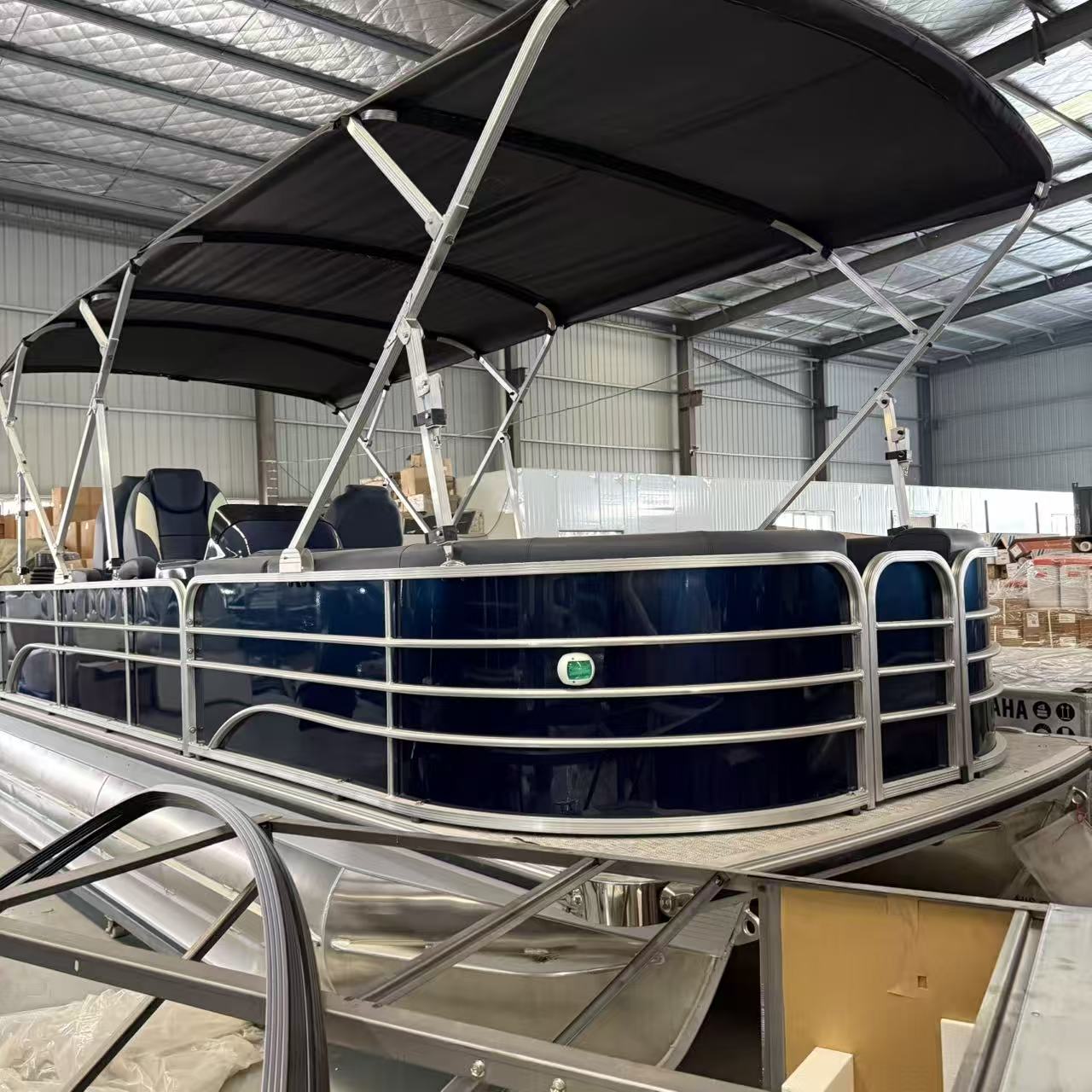
Many first-time buyers mistakenly size their vessel solely around their guest list. In reality, typical water conditions dictate your size requirements just as much as your passenger count. A vessel too small for a large, windy lake creates a terrifying ride.
Compact models serve specific, sheltered environments perfectly. They are best for calm, protected inland lakes or slow-moving rivers. They comfortably seat 2 to 6 passengers. However, their shorter tube displacement creates distinct limitations in choppy water. They tend to bounce over wave crests rather than cut through them. A compact footprint provides excellent maneuverability around tight docks, but you must avoid wide-open bays during heavy winds.
This range represents the undisputed industry sweet spot. A well-built 20 to 22-foot aluminum pontoon boat effortlessly handles moderate chop on standard recreational lakes. It comfortably seats 7 to 10 people without feeling congested. The longer hull bridges the gap between typical lake waves, delivering a much smoother ride than a compact model. This size gracefully supports general cruising, anchoring at sandbars, and light watersports.
You absolutely need larger dimensions for massive, open lakes, coastal bays, or heavy weekend chop. These extensive vessels safely support groups of 11 or more people. More importantly, sizes exceeding 23 feet often require a tritoon configuration (three tubes). The third tube adds massive buoyancy. This allows the vessel to handle the extreme weight of high-horsepower engines ranging from 150HP to over 300HP. Tritoon models cut through aggressive waves and provide ocean-like stability.
Length Range | Ideal Water Conditions | Comfortable Passenger Load | Primary Use Case |
|---|---|---|---|
14 - 19 Feet | Calm rivers, small sheltered lakes | 2 to 6 People | Light cruising, panfish fishing, tight docking |
20 - 22 Feet | Medium lakes, moderate weekend chop | 7 to 10 People | Family entertainment, tubing, sandbar anchoring |
23 - 28+ Feet | Large open lakes, coastal bays, heavy chop | 11+ People | Hosting large groups, wakeboarding, rough water transit |
Your intended daily activities heavily influence the deck layout and overall length you require. A layout designed for dragging kids on a tube looks vastly different than one built for serious angling.
If you mainly host sunset cruises and neighborhood gatherings, prioritize deck square footage. Larger dimensions allow for specialized entertainment zones. You can easily fit rear-facing loungers, dual captain chairs, or massive L-shaped sectional seating. Focus on floor plan flexibility over raw speed. Look for floor plans maximizing walking space around tables. Consider models offering built-in galleys or pop-up changing rooms, which require at least 22 feet of deck space to fit without feeling cramped.
Towing skiers and wakeboarders requires rapid planing speed. Larger pontoons require exponentially larger engines to achieve this necessary lift. A heavy 24-foot boat needs significantly more horsepower to pull a skier than a 20-foot boat. Keep your power-to-weight ratio in mind. Furthermore, watersports require dedicated rear deck space for tow bars and re-entry ladders. If you prioritize watersports, you must balance the need for passenger seating against the massive engine weight required to propel a large vessel.
Anglers generally prefer smaller to mid-sized boats in the 16 to 20-foot range. A compact pontoon boat offers superior maneuverability. It easily navigates tight coves and features a shallower draft for sneaking near rocky shorelines. Less deck space also means you can easily walk end-to-end when reeling in an active catch. Dedicated fishing models often sacrifice plush loungers for four-point pedestal seating, livewells, and rod locker storage. A smaller footprint makes maneuvering around structural pylons much easier.
Many buyers finalize their dream layout only to realize they cannot easily move or store it. You must evaluate the physical infrastructure surrounding your boating lifestyle before signing any paperwork.
Connect the dry weight of your vessel (plus the trailer, engine, and fuel) to your tow vehicle. Check the specific towing payload of your truck or SUV. A standard half-ton pickup easily tows a 20-footer. However, a 25-foot tritoon resting on a heavy-duty tandem-axle trailer might require a three-quarter-ton truck. Always verify your Gross Combined Weight Rating (GCWR). Do not guess these numbers. A vehicle struggling to tow a massive load poses a severe highway danger and damages transmission components.
Buyers frequently underestimate parking requirements. A 22-foot model on a trailer requires much more than 22 feet of physical space. The trailer tongue adds several feet to the front profile. The tilted outboard engine adds several feet to the rear. Expect to need 26 to 28 feet of linear storage space in your driveway or garage. Measure your exact storage depth with a tape measure. Look into swing-away trailer tongues if you have strict garage depth limitations.
Before committing to a massive vessel or a tritoon upgrade, verify your local marina limits. Measure the available slip dimensions at your intended dock. Check for marina width restrictions and turning radiuses. Some older marinas use narrow slips designed decades ago. These easily accommodate traditional V-hulls but struggle to fit an 8-foot 6-inch beam securely. Ensure you have enough clearance to attach side fenders without wedging the boat against the pylons.
Selecting the ideal vessel requires a logical, step-by-step approach. Do not let showroom appeal blind you to logistical realities. Use a clear decision tree to ensure years of stress-free boating.
Prioritize Water Type First: Match your hull length to the wave conditions you will face most frequently. Buy for typical days, not best-case scenarios.
Calculate Maximum Regular Passengers Second: Apply the 70% comfort rule to the USCG capacity plate. Leave room for wet weight, coolers, and gear.
Confirm Towing and Storage Viability Third: Measure your garage, check your truck's GCWR, and verify marina slip limits before finalizing any purchase.
Physically Board Models: Visit a local dealership. Walk the deck to visualize the layout, check sightlines from the helm, and review exact USCG tags in person.
A: The 20 to 22-foot range remains the most popular size across the industry. This footprint perfectly balances comfortable passenger capacity (usually 7 to 10 people) with easy maneuverability. It easily handles moderate chop on standard lakes while remaining light enough for standard half-ton pickup trucks to tow safely.
A: Most models universally measure between 8 feet and 8 feet 6 inches wide. Manufacturers adhere strictly to this standardized beam width. It complies directly with standard highway towing regulations. Designing them any wider would require owners to obtain special oversize load permits every time they use public roads.
A: Adding a third center tube does not typically change the overall length or the 8'6" beam width. However, it drastically alters the vessel's capabilities. A tritoon massively increases overall weight capacity, structural stability in rough water, and the minimum horsepower required to achieve proper planing speeds.
A: Official tube length is measured directly from the front tip of the aluminum cylinders to the rear structural end. This specific measurement excludes the outboard motor, heavy rub rails, and extended swim platforms. Overall Length (LOA) includes these extra components, making LOA slightly longer than the stated tube length.


