
Hot Keywords:
- All
- Product Name
- Product Keyword
- Product Model
- Product Summary
- Product Description
- Multi Field Search
Please Choose Your Language
Views: 0 Author: Site Editor Publish Time: 2026-09-24 Origin: Site


Standard recreational pontoons target casual weekend use. They simply cannot endure the high-cycle, heavy-load demands of commercial operations. Using off-the-shelf models for business applications leads to accelerated asset depreciation. It also risks non-compliance with strict maritime regulations. Maintenance downtime increases sharply when consumer boats perform daily commercial work.
Investing in a purpose-built commercial boat ensures higher operational efficiency. It guarantees passenger safety compliance and secures a verifiable return on investment. This article provides a transparent, specification-driven framework. We help you evaluate, configure, and procure commercial pontoon builds. You will learn how to match hull architecture to specific business use cases. We cover everything from structural integrity to regulatory compliance.
Application Dictates Architecture: Tour operators, rental fleets, and utility businesses require distinctly different floor plans, weight capacities, and hull reinforcements.
Compliance is Non-Negotiable: Commercial passenger builds must integrate Coast Guard (USCG) or local equivalent passenger capacity and safety engineering from the blueprint stage.
Financing & Tax Strategies: Custom commercial vessels often qualify for specific business equipment financing and accelerated depreciation tax benefits.
Many business owners try to save money by purchasing standard recreational vessels. This decision almost always backfires. Commercial operations subject boats to relentless stress. You need specialized engineering to withstand continuous public use.
Retrofitting consumer pontoons for business use carries severe risks. Manufacturers engineer recreational models for light loads and occasional weekend outings. Registering these consumer-grade boats for commercial use immediately voids factory warranties. You also introduce massive liability risks if an accident occurs. Consumer-grade gates, standard rails, and basic hinges fail rapidly under daily public stress. A broken gate on a rental boat removes that vessel from your active fleet. You lose revenue every day it sits waiting for repairs.
A customized pontoon boat extends your asset lifespan significantly. Builders utilize heavy-duty transoms to support continuous commercial engine vibration. They apply upgraded continuous weld patterns rather than weak spot welds. Commercial builders also install larger pontoon diameters. Upgrading from standard 27-inch tubes to 32-inch tubes dramatically increases buoyancy. This allows the vessel to handle daily maximum payloads safely. These structural upgrades prevent hull fatigue over years of rigorous service. You avoid replacing your fleet every two seasons.
You can translate vessel customization directly into daily revenue. Smart deck planning maximizes your compliant seating capacity. You achieve this density without sacrificing passenger comfort or vessel maneuverability. Every extra USCG-approved seat adds direct daily revenue for tour operators. Custom layouts allow you to eliminate wasted space. You can design specific flow paths for quick passenger boarding. Faster turnaround times between trips mean you can schedule more tours per day.
No single pontoon design works for every business model. You must align your deck layout and hull specifications with your daily operations. We categorize these builds into three distinct applications.
Success criteria for rental fleets focus strictly on durability and simplified maintenance. Novice drivers require extremely forgiving vessels. Renters frequently bump docks and misjudge shallow waters.
Heavy-Duty Rub Rails: Require thick rubber inserts to absorb constant dock impacts.
Vinyl Flooring: Eliminate carpet entirely. Carpet traps moisture, breeds mold, and stains easily. Vinyl allows crews to hose down the deck in minutes.
Simplified Helm Stations: Remove complex electronics. Novice drivers get easily distracted by unnecessary screens.
High-Thrust Engines: Specify lower-horsepower motors with high-thrust propellers. This limits top speeds to reduce liability while maintaining low-end maneuverability.
Success requires maximum USCG-approved capacity and high accessibility. Passengers expect a premium, stable experience during sightseeing or dining cruises.
ADA-Compliant Gates: Install wider 32-inch boarding gates to accommodate wheelchairs seamlessly.
Tritoon Stability: Mandate a multi-hull tritoon design. A third center tube provides essential stability for variable water conditions, preventing passenger seasickness.
Integrated Electrical Systems: Include dual-battery setups to power PA systems, architectural lighting, and commercial sound setups.
Modular Seating: Use track-mounted seating systems. You can quickly swap between sightseeing rows and dinner-cruise table layouts.
Operators in utility sectors prioritize raw deck space and payload capacity. They need specialized equipment mounting solutions for heavy tools.
Open-Deck Configurations: Maximize square footage by eliminating built-in lounges.
Reinforced Lifting Strakes: Weld heavy aluminum strakes to the tubes to handle extreme equipment loads.
Structural Mounts: Add thick under-deck aluminum plating. This supports heavy cranes, winches, or dredging equipment securely.
Specialized Tanks: Integrate commercial-grade livewells or chemical storage tanks directly into the deck architecture.
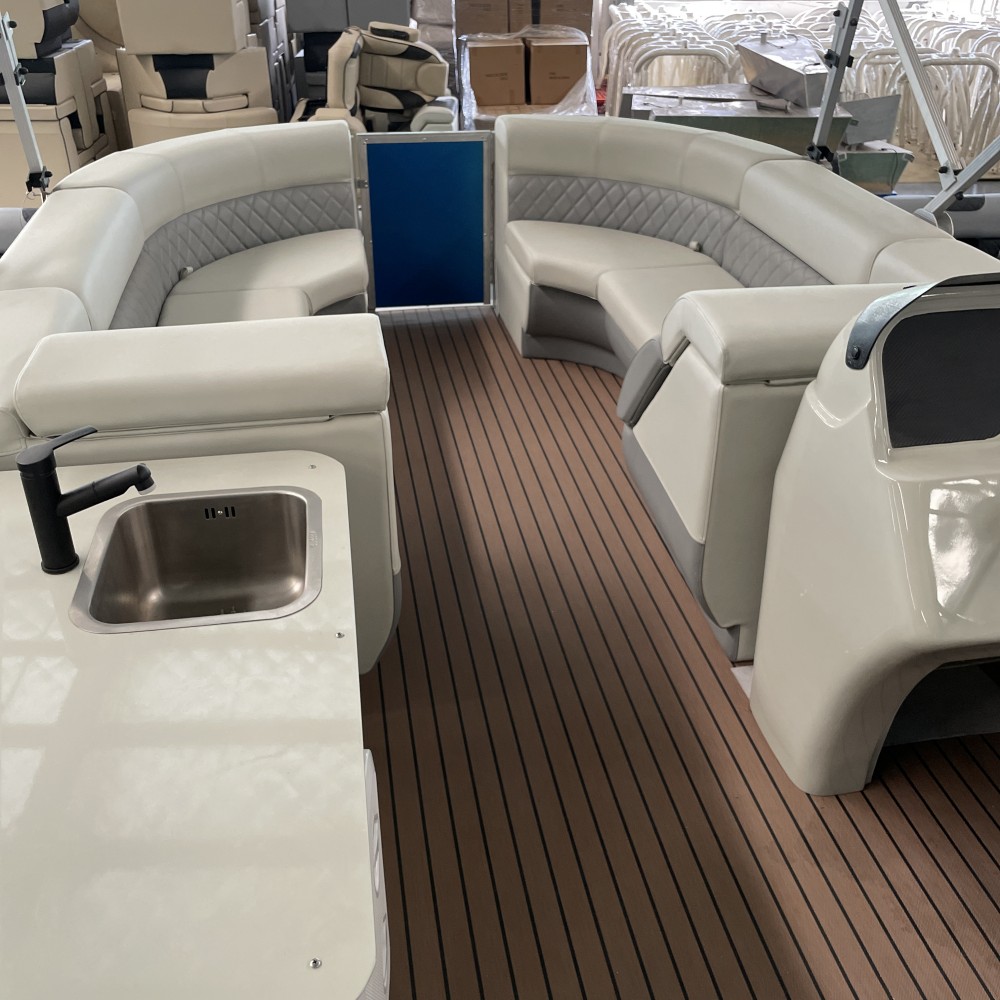
Evaluating commercial builders requires a strict focus on materials. You must look past aesthetic finishes and examine the foundational engineering.
Always evaluate aluminum gauge thickness carefully. Recreational boats often use thin .080" aluminum. Commercial use demands a minimum of .100" to .125" aluminum for the tubes. You must inspect the builder's welding methods closely. Continuous welds provide vastly superior strength compared to stitch or bracketed welds. Ask the builder about internal tube baffling. Commercial pontoons must feature multiple sealed chambers inside each tube. This prevents catastrophic flooding if a hull punctures on submerged debris.
You must understand how equipment customization impacts payload calculations. Adding heavy cranes or large seating blocks changes the center of gravity. Ensure your builder provides certified stability tests. They must issue proper commercial capacity plates before delivery. USCG regulations heavily scrutinize stability on multi-passenger vessels. Operating without proper commercial certification exposes your business to severe fines.
Consider how quickly mechanics can replace wear-and-tear components. Cleats, bimini hardware, and gate hinges break frequently in commercial settings. Boat customization should prioritize standardized, easily sourced replacement parts. Avoid proprietary hardware causing weeks of operational downtime. Your builder should provide a detailed parts manifest for quick local ordering.
Recommended Hull Specifications by Application
Application Type | Minimum Aluminum Gauge | Recommended Tube Setup | Ideal Deck Material |
|---|---|---|---|
Rental Fleets | .100" | Twin 27" Tubes | Marine-Grade Vinyl |
Tour Charters | .100" to .125" | Triple 32" Tubes (Tritoon) | Woven Synthetic Teak |
Work & Utility | .125" or higher | Twin or Triple Heavy-Duty Tubes | Diamond Tread Aluminum |
Procuring commercial vessels differs significantly from buying a personal boat. You must navigate OEM relationships, longer timelines, and specialized financing structures.
Consumer dealers sell pre-configured units optimized for casual buyers. Partnering directly with an OEM pontoon boat builder is a much better strategy for businesses. An OEM partner produces scalable, standardized commercial fleets. They engineer vessels specifically for your operational environment. OEM engineers understand commercial liability and structural compliance standards deeply. Buying direct also removes dealership markups, leaving more budget for structural upgrades.
You must manage operational expectations carefully. Custom commercial builds require longer lead times than consumer models. Expect timelines ranging from three to six months. Supply chain availability for raw aluminum affects delivery dates heavily. Seasonal manufacturing peaks also delay production. Plan your fleet orders well before your busy season begins. Do not expect off-the-shelf delivery speeds for specialized engineering.
Commercial vessels require distinct financial mechanics. Specialized fleet financing structures exist specifically for maritime operators. These setups often improve cash flow significantly compared to traditional consumer loans. Asset depreciation programs provide robust tax advantages for businesses. In many jurisdictions, commercial boats qualify for Section 179 tax deductions or similar accelerated depreciation frameworks. Always consult a certified financial advisor regarding maritime asset depreciation before finalizing your purchase.
Approaching a builder without a rigid spec sheet wastes time. You must define your operational parameters clearly before discussing price.
Step 1: Define Payload & Environment. Document your expected maximum weight accurately. Calculate the combined weight of passengers, crew, and specialized gear. Define your operating water conditions clearly. Calm inland lakes require different hull architectures than coastal ocean chop. Coastal operations demand upgraded saltwater anti-corrosion packages.
Step 2: Require Commercial Warranties. Standard recreational warranties vanish upon commercial registration. Demand transparent warranty terms explicitly covering business use. Ensure the warranty covers structural elements like transoms, deck supports, and welds. This protects your investment against premature structural failures.
Step 3: Request Prototype to Fleet Scalability. Ordering multiple units requires extreme caution. Establish contract terms for a single prototype build first. Test its functionality in your specific water environment. Let your staff operate it daily to identify ergonomic flaws. Only authorize full fleet production after validating the prototype perfectly.
A custom pontoon boat operates as a dedicated revenue-generating asset. It is not just another maritime vessel. Purpose-built commercial pontoons maximize passenger safety and extend your operational lifespan. They eliminate the high maintenance risks associated with consumer-grade models. Proper customization directly influences your daily profitability.
Your next step requires data collection. Gather your daily operational pain points from your captains and maintenance crew. Document your desired passenger capacities, payload limits, and equipment mounting needs. Compile these technical details into a formal Request for Proposal (RFP). Send this RFP to qualified commercial OEM builders to secure accurate, transparent quoting.
A: Commercial builds generally cost 20% to 40% more upfront than standard consumer models. This premium covers thicker aluminum gauges, continuous welding, heavy-duty deck materials, and larger tubes. While the initial purchase price is higher, the extended durability drastically reduces long-term maintenance expenses.
A: We strongly advise against this practice. Registering a consumer boat for public rental immediately voids the manufacturer warranty. It exposes your business to severe liability and insurance denial risks. Standard gates, rails, and seating simply cannot withstand daily public abuse without failing.
A: Yes. Any structural change alters the vessel's center of gravity and weight distribution. Upgrading seating capacities or adding heavy equipment requires a completely new stability test. Your builder must secure commercial recertification to ensure absolute passenger safety and legal compliance.


