
Hot Keywords:
- All
- Product Name
- Product Keyword
- Product Model
- Product Summary
- Product Description
- Multi Field Search
Views: 0 Author: Site Editor Publish Time: 2026-06-09 Origin: Site


Modern buyers demand highly multi-functional watercraft. The traditional pontoon is often viewed as a slow, flat-water cruiser designed for gentle sunset rides. However, buyers evaluating a modern sport pontoon boat require much more. They need a vessel capable of aggressive tow sports, deep-water diving, and high-speed transit. Importantly, they want these capabilities without sacrificing the platform's inherent comfort and passenger capacity.
A successful purchase hinges on selecting the exact right combination of hull hydrodynamics, structural tow points, layout configurations, and propulsion. You must handle dynamic physical loads safely on the water. This comprehensive guide breaks down the specific structural upgrades, deck features, and sizing considerations required to legitimately support wakeboarding, freediving, and fast cruising. You will learn exactly what specifications to prioritize to ensure maximum performance and safety.
Hull Design is the Baseline: Standard twin-tubes cannot safely support aggressive tow sports; a tritoon chassis with lifting strakes is non-negotiable for fast cruising and wakeboarding.
Tow Towers Over Ski Pylons: True wakeboarding requires structural tow towers integrated into the chassis, not standard deck-mounted ski pylons.
Size Dictates Function: A nimble 19-foot model excels at agile towing, while a 25-foot tritoon provides the deck space and displacement necessary for heavy diving gear and large passenger loads.
Power Minimums: 150HP is the absolute baseline for towing adults; 200HP+ is required for loaded fast cruising.
You cannot build a high-performance vessel on a weak foundation. Evaluating a three-tube configuration is mandatory for active buyers. Physics dictate this requirement. When passengers shift to one side, a traditional twin-tube boat leans heavily. Divers recovering heavy gear cause massive lateral weight shifts. A wakeboarder cutting hard outside the wake generates immense side-pull. A third center tube provides vital counter-buoyancy. It fights this lateral torque. It keeps the deck flat, stable, and safe during dynamic activities.
Achieving true sport performance requires specific hydrodynamic Features & Options. You must look beyond the basic tubes.
Lifting Strakes: These are aluminum extrusions welded horizontally along the tubes. They break water tension. Instead of plowing through the water, strakes force the heavy hull to lift. This allows the boat to plane effectively. It is the only way to achieve legitimate fast cruising speeds.
Aluminum Underskinning: Consider this a critical evaluation point. Standard pontoons leave the deck cross-members exposed underneath. Water surging upward hits these members. This causes immense drag. It creates structural fatigue and guarantees a rough, noisy ride. A fully shielded, aluminum underskin eliminates this drag. Water glides smoothly under the deck.
Transom and Engine Brackets: High-speed cruising requires massive horsepower. Standard motor pods will bend under the stress of heavy 200HP+ outboards. You must specify heavy-duty, reinforced transom brackets. These handle the intense torque generated during rapid acceleration.
Tow sports place severe stress on a boat's frame. You must evaluate tow point integrity carefully. Standard ski tow bars work fine for dragging inflatable tubes. They sit low on the aft deck. However, wakeboarding demands a high, upward pull. Upward pull keeps the rider on the surface. It provides the necessary leverage for jumps and tricks. Therefore, true wakeboarding requires a structural wakeboard tower. Manufacturers must integrate this tower directly into the chassis framework. Deck-mounted pylons simply cannot withstand vertical hang-time forces safely.
You must also set realistic, evidence-based expectations regarding wake generation. A properly configured Sport Pontoon Boat provides an excellent platform for most tow sports. It creates a clean, firm wake perfectly suited for wakeboard jumps. It tracks straight under heavy load. However, it cannot safely produce the massive displacement wave required for wakesurfing. The hull design inherently disperses water rather than plowing it into a surf wave.
Finally, consider your spotter layouts. Safe towing requires constant observation. Evaluate rear-facing lounges and aft deck configurations. Ensure they meet legal requirements for observer seating. The spotter must sit comfortably facing backward. Crucially, their seating position must never obstruct the captain's line of sight or access to the helm controls.
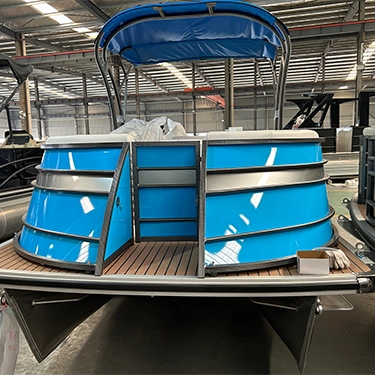
Diving introduces entirely different physical demands. You must prioritize specialized boarding infrastructure. Standard boarding ladders fail easily here. Flimsy aluminum steps will bend or snap under the combined weight of an adult diver and twin air tanks. You must specify heavy-duty boarding equipment. Recommend a 4-step, stainless steel ladder. Ensure it features a deep plunge depth. The bottom rung must reach far below the waterline to accommodate divers wearing heavy fins.
Deck and flooring choices also require an upgrade. Legacy marine carpet holds moisture. It traps odors and hooks easily on dive gear. Modern sport vessels must transition to advanced materials. Evaluate the following flooring options:
Flooring Material | Slip Resistance | Drainage & Cleaning | Best Use Case |
|---|---|---|---|
Woven Vinyl | High (Even when wet) | Rapid draining; hoses off easily | Scuba diving, fast cruising, saltwater use |
Closed-Cell EVA Foam | Very High (Soft grip) | Does not absorb water; resists stains | Wakeboarding, swimming, barefoot comfort |
Legacy Marine Carpet | Moderate | Holds water; prone to mold | Avoid for active sport applications |
Gear staging requires thoughtful layout planning. Outline the need for extended aft swim platforms. Divers need space to perform safe giant-stride entries clear of the outboard propeller. Additionally, deep, under-seat storage is mandatory. Check the clearance dimensions beneath the lounges. Ensure they offer adequate space for bulky BCDs, long freediving fins, and compressed air tanks.
Vessel size dictates its primary function. Frame the size decision strictly around your primary use case. Doing so prevents under-powering your boat or buying unnecessary capacity.
The 19ft Sport Pontoon Boat serves a specific, highly active buyer. It is exceptionally maneuverable. The shorter hull responds rapidly to helm inputs. This makes it highly agile for towing wakeboarders through tight turns. It also fits standard garages and trailers easily.
However, it presents specific limitations. Deck space remains inherently limited. Staging multiple divers and their gear becomes cramped quickly. Furthermore, shorter hulls are susceptible to bow-diving. When navigating heavy chop, the shorter tubes can plunge into wave troughs rather than bridging them.
Conversely, a 25ft Party Tritoon Pontoon Boat prioritizes payload and rough-water dominance. It provides massive weight capacity. You can easily host 10 or more passengers while storing full dive loadouts. The longer chassis spans wave troughs effectively. This structural length delivers incredibly smooth, fast cruising in rough coastal or large lake waters.
The risks involve power requirements and logistics. Pushing a 25-foot heavily loaded tritoon requires massive horsepower. You often need 300HP or more to maintain tow-sport agility. It also demands specialized tandem or triple-axle trailers for safe transport.
You cannot fake horsepower on a pontoon. Pontoon hulls push water differently than fiberglass V-hulls. You must use an expert evaluation framework for horsepower-to-weight ratios. A 115HP engine on a fully loaded vessel will fail your performance test. It simply will not pull an adult wakeboarder onto a clean plane. The drag is too immense.
We recommend strict power minimums based on intended usage.
150HP: This is the absolute minimum requirement. Use this baseline for basic tow sports on sub-22ft boats carrying light passenger loads.
200HP - 300HP: This range is strictly required for high-speed cruising. You need this power block for aggressive tow sports on a fully loaded 25ft tritoon.
Implementation risks extend beyond the engine block itself. High-speed cruising demands an aggressive throttle. You must select the correct propeller. Propeller pitch determines your performance profile. A stainless steel propeller flexes less than aluminum under heavy torque. Selecting a lower pitch increases low-end towing torque. Selecting a higher pitch optimizes top-end speed. You must consult your dealer to pitch the prop specifically for your primary sport.
Do not rely solely on marketing brochures. You must verify a boat's structural limits independently. Always check the NMMA (National Marine Manufacturers Association) capacity plate. This plate dictates maximum horsepower ratings and total passenger weight limits. Ensure the rated limits exceed your combined gear and passenger estimates.
The sea trial is your ultimate proving ground. Instruct the dealer to load the boat with realistic weight. Do not test an empty vessel. Follow these specific testing steps during your demo:
Load the Deck: Place heavy gear or passengers in the aft and mid-ship sections to simulate a real outing.
Test the Hole Shot: Accelerate aggressively from a dead stop. Note how many seconds it takes to reach a flat plane.
Execute a Hard Turn: Turn sharply at 20mph. If the boat banks outward heavily instead of leaning inward, it lacks proper performance lifting strakes.
Observe Draft Under Load: Have passengers shift to one side. Verify that the tritoon chassis keeps the deck reasonably level.
Advise buyers to prioritize chassis and engine upgrades over cosmetic features. LED lighting packages and premium audio systems can be retrofitted later. Adding a third center tube is structurally difficult. Upgrading an underpowered outboard engine later is highly inefficient. Secure the hull and power foundation first.
Combining wakeboarding, diving, and fast cruising on a single vessel is entirely possible. However, it requires deliberate engineering choices. The buyer must commit to a tritoon chassis. High horsepower outboards and sport-specific structural integrations remain mandatory.
Always prioritize the foundational build over aesthetic options when finalizing your build sheet. Secure the correct hull layout, maximum engine capacity, and durable flooring first. Everything else is secondary.
Take action today. Review manufacturer spec sheets carefully. Use online build-and-price tools to mock up your ideal configuration. Most importantly, book a weighted sea trial with your local dealer to verify the performance firsthand.
A: No, unless it is a specialized forward-drive pontoon. Standard outboards pose a fatal propeller-strike risk for wakesurfing. Wakeboarding (which uses a 50ft+ rope) is safe and common.
A: A tritoon is strictly necessary for fast cruising and sports. Pushing a twin-tube boat with a massive engine causes the bow to plow, creating dangerous handling and inefficient fuel burn.
A: Factory-installed structural towers are designed to handle the dynamic pull of one adult wakeboarder (typically up to 600 lbs of tow force). Always verify the manufacturer's tow rating, and never use a high tower for towing inflatables/tubes, as the submarine effect of a tube can snap the tower.


